About Me

My photo
Southern France
Lynn Deasy is a freelance writer, author, foodie, and garden tinkerer. She lives in a 600 year old house in southern France with her husband, Christophe. Currently, she is looking for a literary agent for her memoir CA VA? STORIES FROM RURAL LIFE IN SOUTHERN FRANCE which examines the oddities of French provincial living from an outsider’s point of view through a series of adventures that provide more than a fair share of frustration, education, admiration, and blisters…. yes, lots and lots of blisters. Lynn blogs every Monday, Wednesday, and sometimes Friday.
Showing posts with label Rural life in France. Show all posts

Wednesday, September 26, 2012

Apple Pickin’


There’s nothing wrong with going to an orchard to pick apples, but nothing can beat walking out the front door and finding this in a matter of minutes:


Friday, September 21, 2012

Wood heat


Wood in the garden
There you have it, while heating season hasn’t started yet wood season has.  We heat by wood and we don’t buy it, we collect it from fallen trees in the area.  Autumns can have warm days, cool nights, and can last pleasantly long.  Sometimes, we don’t light the first fire until October and when we do, we only heat in the evening as a question of comfort rather than need.  On the other hand, this mid-season can also be cold and wet, so we need to prepare while the weather is still good.

For the last two months, Christophe has been collecting wood for the season.  If a tree is cut, it’s too fresh to burn that year, so it’s left to dry.  This year, he’s collecting fallen trees for this year’s heating season and cutting some with neighbors.  Basically, he’s working two years of wood at the same time, but that’s common, at least for Christophe.

Once the wood finally makes it into our garden, it is cut, split, and stacked.  I cannot say exactly how much wood we burn.  In France, wood is measured in stère or in cubic meters, not cords, but I can say when it runs the entire length of the garden wall Christophe stops worrying if we have enough.  How many cubic meters is that?  He has calculated that, but like any heat source, it’s used in relationship to the weather, most of the time that is enough, but there are exceptions.  Late last winter, it was terrible cold, and we burned through stacks of wood in no time; however, up until December, we only light the heater in the evenings.

For those who don’t heat by wood I’m certain this idea is a bit archaic.  Some think we contribute to deforestation, but the forest gains 5% of agricultural grounds each year and needs to be trimmed back; after all, France is an agricultural country.  And, most of our heating wood comes from fallen trees.  We are actually cleaning the area by removing dead wood that could contribute to a forest fire.  Our heater, or poéle, has a double combustion, meaning it re-burns gas that escapes from the burning wood; the CO2 output is as minimal as it could get.  

Then there are others who think heating by wood is rather romantic.  Honestly, it is, after you get past the cutting, splitting, stacking, and hauling it in everyday.  Heating by wood simply is what it is: hard work, but there’s a satisfaction is knowing it’s done and turning up the heat by throwing another log in the fire isn’t going to change the heating bill – as if we have one.

Wednesday, September 19, 2012

Friday, September 7, 2012

Why I like the French Post, or Why Private Couriers in France Stink


I guess I had bought into the hype when I thought using a private courier, like UPS or Fedex, was better than the post office.  The US Post Office has a reputation and when I moved to France, I transplanted that image.  I was wrong.  The mail couriers play a vital role in French rural life; they do more than just bring the mail.  For many, this is the only person seen all day.   They bring news of life elsewhere, weather on the other side of the ridge, and sometimes, bread from the bakery.  There are many changes happening to the French postal services to conform the EU regulations, many not for the better, but I will always choose this public service over private every time.  The reason is simple: they bring me my mail.  It’s an easy thing, but strangely enough, private services cannot seem to wrap their heads around that idea; a service paid should be a service delivered – pun intended.  Allow me to illustrate:

We recently ordered an item online, which I found in the hands of my three year old daughter when I picked her up from school.  Earlier that day, the driver had called to see if I would be home, and in my excitement about the first day of school, said I would be available until the end of the school day.  My daughter’s school is in a nearby town, more conveniently positioned on his route, so he took the liberty of interrupting 100 students who most likely confused the doorbell for recess.  I wish I could say this is the only time a problem has happened, but it isn’t.

After getting married, I got a new passport from the US Consulate in Marseille.  I was required to use a private courier and sign for the package to insure it would be received.  I never got a chance to sign for it.  It was given to a village resident who falsely presented himself as the mayor and the courier handed it to him without question, or my signature.  He in turn, handed it off to someone who eventually gave it to me.  That’s right, an American passport, highly prized for its price on the black market, passed through at least two hands before I got it.

And of course there was the time when a courier flat out refused to deliver to us saying it was too far and “gas costs money”.  We had to call the company we ordered business supplies from to finally get the delivery through.

This is just a small example of what has happened.  The large couriers outsource their deliverers which get outsourced again and we have some John in a run-down pick-up truck complaining about where we live.  Private couriers in France stink - period.

Did I tell you about my wedding dress I bought in the US and had shipped to me in France?  It came to me in one piece, uncrushed, and without a complaint.

I used the post office.

Wednesday, September 5, 2012

The Patisson


Smaller patissons can be seen forming over the right patisson.


This odd vegetable has graced our garden for the last few years; the patisson.  It is also called the pattypan, scallop squash, granny squash, and the bonnet-de-prêtre.  A first, I didn’t know what to do with it, but I’ve found that the more I use it, the more I find uses for it.  It’s in the squash family, but don’t mistake it for a butternut or acorn.  It’s more like a zucchini, but firmer and nutty in flavor.

Besides running around the kitchen playing Pac Man with them, (Come on, they do look like the ghosts, don’t they?) I’ve stuffed them, put them on pizza, sautéed them, and put them into every dish possible.  We have both the yellow and white varieties, but I find the yellow to be more prolific and more resistant to diseases.  The plant itself can be 5 feet in diameter, so I feel rather successful as a gardener when these giant Amazon like plants quickly fill any empty space left in the garden.  I’ve found little history and background on them, expect, according to Wikipedia, the name comes from “a Provençal word for a cake made in a scalloped mould”.

Close up

Monday, September 3, 2012

Monday's Leftovers: Autumn’s Presence

In France, Sunday lunches are sacred.  They are a time for family and friends to gather together, put the work week on hold, and come back to the table to the things that inspire.  We participate in this ritual that allows us to spend time together and reflect upon our good fortune.  Growing up, my family also had our Sunday brunches, so coming back to this tradition is a welcomed addition to my weekend.  Monday’s Leftovers is a periodical series that recaps those moments, the lunches, and the memories that are left long after the dishes are done. 


Sautéed Salmon, Patisson-Eggplant-Tomato Lasagna, Tomato Confit

Literary overnight the weather changed from a scorching 95 degrees to blustery weather in the high 50s.  Autumn announced itself very profoundly and reminded us what waits just around the corner.  Grey clouds crammed the sky while 55 mile an hour winds whipped around.  We ventured very little outside.

Early September is normally the ideal moment of fall: cool nights, hot days, and harvest time.  This is late fall weather, not early September.  The calendar calls for daily garden tours and menus revolving around what is ripe, but the weather is screaming, “Turn the oven on and slow cook something with a heavy sauce”.  Lunch fell somewhere in the middle.  Christophe slow cooked fresh tomatoes and for the first time in months, we were happy to have the radiant heat from the oven.  The aperitif was sipped indoors, windows closed, and sweaters were dug out from the back of the armoire.  The temperatures are predicted to climb back to seasonal norms by the end of the week, but we were quickly reminded what lies ahead and why we should revel in the end of the summer while we still have it.
Menu:

Entrée: Sautéed White Patisson, Eggplant, Toulouges Sweet Onions, on Napa Cabbage
Plat Principal: Salmon Filet with Fennel Sprouts, Vegetable Lasagna, and Tomato Confit

Monday, August 6, 2012

Night Watch


The garden at night.

The drought has taken its toll on quite a few things: trees are suffering, there are water restrictions, and even the animals are acting a bit odd.  The blue jays that attacked our fig tree have now striped it bare and we have discovered a new problem: foxes, or at least we think they are foxes.

For the last few weeks we have found an animal has dug up part of the garden.  It’s not attacking the vegetables, but it’s digging in the dirt leaving giant holes and unearthing the plants.  We think it’s burrowing for worms or any other form of nutrition.  At first we thought it was cat, but the damage was far too extensive.  Then the idea of a boar developed, but it couldn’t have been one both since the damage was not nearly enough and the potatoes have been left untouched (boars like potatoes).  It’s most likely not a dog, so all fingers started pointing towards a fox.  We’ve already lost a few plants to the digging, and unearthing the plants each morning that have been buried is time consuming, so we’ve had to act defensively.  Each night around midnight we go out to the garden and wait.  It sits at the edge of the property next to small cliff that plunges into a forest below which harbors anything from deer to boars to foxes.  We wait for any sound from the darkness and when it happens, we go on the attack, hurling rocks into the tree tops above so the sound amplifies and frightens the animal.  After a small barrage, we stop and hear it scurrying away.  It works, but it’s not a permanent fix; if we don’t go out to defend the garden each night the animal comes back.  It’s changing our night rituals and stretching out long days even longer.

I admit venturing into the garden so late at night with an active imagination is not always fun.  Sometimes, I’ve darted back to the house after the barrage in fears of the animal taking advantage of my turned back and wanting revenge.  I lock the door after me, happy to be in a well light kitchen and knowing that animals, without opposable thumbs, can’t turn knobs, rendering me safe from their grasps.

Gardening has taken a very odd turn.  I’m losing sleep over a pumpkin and dream about animals that can unlock doors.  The growing season can be quite long, so I’m impatiently waiting for its end when everything can be gathered from the garden and my nights can spent indoors where they are supposed to be.  For now, all I can think is, “That pumpkin better be damn good.”

Friday, July 6, 2012

Garden Enemy No. 1

It’s not to occasional mouse that sneaks away with a strawberry now and then; it’s not the burrowing mole unearthing the potatoes before their time; it’s not the neighbor’s cat that sneaks into the garden at night, twirling up twine and rolling in the dirt as if it’s been sprinkled with catnip; garden enemy number 1 is this thing:

The white worm.

It can make a plant go from looking like this:


To looking like this:


The transformation is almost overnight.  It eats the plant’s roots, so as we mindfully tend to the plant above, the beast is destroying it from below and we are completely unaware of it until it’s too late.

Christophe’s plight against this intruder is well documented amongst friends.  He once was spotted carefully hunting a worm that has made its way down a row of lettuce.  When he finally excavated the critter, it was green and as fat as a finger.  Christophe’s triumphantly crushed it on some stones.  He still recounts the incident like an old war story – with a glim in his eye knowing the enemy has been vanquished.

During planting season, I ran across quite a few, all who meet their dome in a similar fashion.  I can share a berry or two, but a whole plant is a bit too greedy.    

Monday, July 2, 2012

Running Hot


There’s been a revolution in this 600 year old house we call home, something that it’s never seen before, something that most everyone takes for granted.  We got used to living without it, but its presence is something we quickly adapted to: hot water in the kitchen.  That’s right, for the entire existence of this house, including the six years I’ve lived here, there has been no running hot water in the kitchen.  That all changed this last week.  Thanks to the hard work of a dear friend, we are no longer obliged to get hot water from the bathroom to do the dishes.  Well, in the summer that is; in the winter we heated water in a kettle on the wood heater.

You might ask how one accepts that, from living with modern convinces to stepping back a few generations in simplicity.  I don’t have an easy answer.  It’s something one gets used, something we would think about fixing, and then something that would get bounced back farther down on the ‘To Do” list.  The project was always there in front of us, but there were obstacles.  The stone sink is small and shallow and the window above it ruled out most facets.  It was our friend, not us, who eventually found two possible fits after searching one of France’s largest metropolitans; both options were found in a specialty shop known mostly only to professionals.

New pipes were fitted and old ones removed, revealing a few surprises.  Once again, nothing “standard” was found and pipe locations had to be moved to place the hot water logically on the left side.  A new spigot was formed to fit the shallow sink and pipes were meticulously checked and rechecked to make sure they were level.  It was more than a job well done; it was something that removed one of the funky quirks of the house – the explanation to those who visited there is an amendment to the manual.  It made things more normal; at least as normal as anything in this house can get.

Even though we live in a house that is older than the United States, I have been given back a bit of modernity and a chance to have “been there, done that” and come out on the other side more grateful for the little things I have.

Now, if the dishes only washed themselves.... yes, that would be something.  What’s that you say?  There is something called a dishwasher?  I’ll have to check into that.

Friday, June 29, 2012

When Nature Bites Back

I'm once again doing a re-blog, but have full intention to be back on Monday.  Work in the house ran into an unexpected hiccup in the form of a broken water pipe.  Need to say, it needed my attention along with a bucket, a mop, and lots of rags.  Details to follow soon, but until then, watch for these in the garden.
Orignal post July 1, 2011


Ever reach down to pull out a weed in the garden and think you’ve just got bitten by a viper?  If so, then you know about stinging nettle, or ortie, as it is called in French. It grows in the region and some has found an unwelcomed home in our vegetable garden.  I’ve never seen it before, so I was very unpleasantly surprised when the weed I unearthed bit me back.  I found out the little hairs that cover the plant act like tiny hypodermic needles and injects chemicals into whoever touches it and that is what causes the burning, screaming, swearing, and oh, yes, blistering.  Christophe chops it down each year with an industrial size weed-wacker, but it keeps coming back.  For those who are crazy enough, certain varieties of stinging nettle can be eaten painlessly, but I’m not willing to take that risk.  We have, however, have found it to be a good fertilizer.  The weeds ferment in water for two weeks, are removed, and then the green mixture can be diluted with water for occasional use.  It does work, but the smell of the fermented mixture is not for the weak stomached.

Stinging nettle: a new experience for me, albeit, an unwanted one.  It makes me pine for the poison ivy summer filled days.  Oh, how I miss thy.

Friday, June 22, 2012

Cool Stuff We Found in the Dirt


I’ve always dreamed of finding some hidden treasure buried deep in the dirt; something of value and something with a story to tell.  I didn’t grow up near the sea or the ocean, so finding a hidden pirate treasure was impossible, but I still imagined that I could.  I dreamt up some far-fetched story of how the treasure chest would make it to suburbia and somehow not catch the eye of anyone until I came along.  I remember finding a fossil when I was younger and thinking I was great explorer.  That is why I liked the film The Goonies; it built upon that fantasy and took it a few steps even farther. 

As we are clearing the field I wrote of the other day, we are finding a lot of things, no gold, but some pretty cool stuff.   None of it is ancient or of real value, but there’s a story behind each thing, even if we don’t know it yet.  I have to leave that part to my imagination.
Here’s a quick look:

This looks to be some type of harness; it’s heavy and properly made of iron.  The pieces were found in different parts of the field.  I imagine an old mule shrugging off the pieces on his very last plow before he collapses from exhaustion.

This could be part of the harness too, but this is hand forged.  Its surface is bumpy and irregular.  Since it is hand forged, it might be older than the harness.

A bottle.  It stands about 4 inches high and has verre perdu or “lost glass” etched on the bottom.  Like the old 8 pack of Pepsi, glass bottles required a deposit.  Verre perdu dates sometimes after deposits were no longer used and before recycling was common place.  It is now sitting on the chimney mantle holding three roses.

Another bottle.  It looks like a 7-Up bottle and it too has verre perdu etched on the bottom.  This bottle is about 6 inches tall.


Bones; more specifically, animal bones for the morbidly curious.

A small pail.  It’s been crushed, but this looks like something used on a farm.
 

Some funky glass pieces.


Wednesday, June 20, 2012

L’épierrage


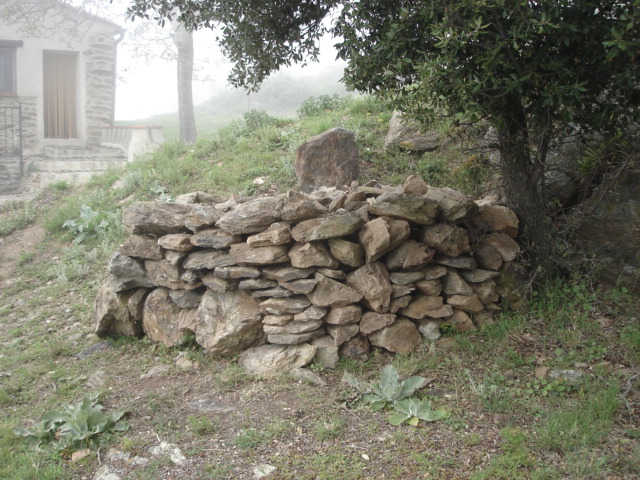
The rock pile as of June 20th.

The rock pile on May 10th; notice the large vertical stone is longer visible.

L’épierrage (French, noun): To remove stones or rock from the soil.

That is what we are doing: l’épierrage.  We are transforming a field that hasn’t been cultivated in over a generation.  The parcel is hot, very dry, and the dirt is compacted down from years of neglect.  The field had to be cleared, fenced, tilled, and then tended to; we’ve been working every spare moment on it for over a month.  Up until now, we were in a fight against time as rising temperatures would soon make the land too hard to till.  We made it, but we are still in the “tending stage” before anything else can be done.

Part of the “tending stage” is removing the rocks, more specifically, slate rock.  Our garden was once filled with them and Christophe meticulously removed and built a terrace wall 6 feet high and 30 feet long.  Now, it’s my turn.  So far, we’ve removed over 3 ½ tons of rocks, one bucket at a time.  Christophe thinks this is one of the hardest, most tedious jobs in agriculture, that is, expect le déssouchage.  That means to dig up tree trunks once they’ve been cut down.  But I knew that already, I did that before I started on the rocks.

Rocks are removed one bucket at a time.

Friday, April 27, 2012

Into the Mist


Spring brings a lot of changes in the weather, and one of the most intriguing is the fog.  Many mornings, we wake up to low hanging clouds that envelope the village.  They rest eerily right in front of us, distorting our view across the square or completely blocking out the mountains that face us.  Colors stops at the end of the terrace, ten feet in front of us, where the world plummets into a hazy gray.

Then, the morning mist slowly starts to burn away.  The sun fights to make its way through, sometimes it wins, other times it doesn’t.  The haze lifts, hovering on the mountain crest, revealing the lower ridges emerging with spring’s green growth.  By midday, the fog has passed; blue skies appear and colors burst with spring’s eternal promise.

Other times, the fog stays.  Clouds rise and fall like the ebb and flow of the ocean.  Moving quickly, the clouds rush in swallowing up all the color and light, only to give way again letting a burst on sunshine make its way through temporarily.  The clouds retaliate and move in with a surge of energy that gives the notion that it is a living creature fighting for its life.  It mutes out the hues and blankets the landscape again with its wispy forms.  This ballet lasts all day long, finally only giving in to the waning light of the approaching night.
 
The fog casts a foreboding air wherever it hangs; but in an ancient village, where thousands of lives once toiled to create the stone facades I now see, it adds an almost wicked dimension.  As if around any corner a phantom of a deceased inhabitant is shrouded in the mist, watching.  The stories are numerous, and the fog gives birth to ghost stories and haunting to an active imagination.

Friday, April 20, 2012

Rural Living and the Challenges of Utilities

View from the terrace

One of the oddities of living where I do is, well, the utilities.  The lights we switch on, the water that runs, the internet that is supposed to keep me connected to world doesn’t always work as I hope.  More than once, I’ve turned on the facet to hear nothing but a dry gasp of air; found the lights flickering for a simple rain storm, and the internet go out because some phone company worker has accidently unplugged us.  And that “us” is the entire village.  That’s what happened Wednesday; I was about to publish the blog post and I found myself without the internet.

When the internet works, it has been dodgy and sporadic lately.  At the end of last year, the village started to bury all the power and phone lines into the ground; the work’s not done yet.  All the electrical lines are buried and active, but the phone lines still hover overhead.  During part of the work, a phone poll was broken, sending the once airborne, and live, line crashing to the ground.  The once very reactive and publically owned phone company has become privatized and subcontract work out, so the line lay on ground for over a week.  Temporary repairs have been made, but the line is at waist level and run next to a field where cows graze.  I don’t think I need to explain what could happen next.

This is just one of the challenges we face living where we do. We don’t like it; we accept it. There is neither a WIFI café next door nor a hotspot with a reasonable radius.  DSL internet arrived just a few years ago to the village and satellite followed shortly after.  This too tends to have its share of problems since the tower signal is known for not being strong enough to pass over the mountainous territory.  Not that I think it’s normal that Christophe has to lean over the terrace to find reception on his cell phone, or that the reception on digital television is worse than analogy, but it’s something we’ve get used to.  Living in a place like this gives a whole new definition of “normal”, which at least gives us something to talk about when the lights go out, yet again.

Wednesday, March 21, 2012

What’s the matter? Are you Chicken?


During Sunday’s lunch of Coq au Vin, there was a lot of chicken talk, that is, about raising chickens.  I’ve been kicking around the idea for some time, and it only seem natural since we have the space and France has that crazy fascination going on with the egg  At times, my mind gets off track and I imagine myself working through dozens of French recipes with all the fresh eggs I’ll have on hand.  Christophe warns the egg fanaticism is a slippery slope that, once on, is hard to get off.  I’ve contemplated his warning, and decided that I’m willing to take that risk.  Heck yeah – fresh eggs!

While Christophe might not be much a big fan of raising chickens, he’s slowing coming around to the idea of having some.  He knows chickens from his uncle’s farm, and is starting to discuss where we could build the chicken coop.  He knows what to feed them and why.  Christophe confirms what everyone has been telling me all along, “they are no work at all.”  Well, I don’t think that all true since they are animals that need to be feed and properly sheltered, but what I think everyone is really saying is they are very little work with fresh eggs in return.

As with any investment, there are risks.  In this case, it’s foxes.  Our neighbors had five chicks picked off one by one over the course of a week in broad daylight.  Clearly, they weren’t happy.  Foxes tend to prowl at twilight hours, so this one was particularly brave, or hungry. Raising chickens presents the responsibility of being present daily; a quick tour to close their coop and make sure they are safely inside only takes a few minutes, but it means being here.  With few exceptions, we are.  We don’t eat dinners at restaurants and when we do pass an evening with friends it’s almost always in the village.  In some way, this should be a no brainer, but there are weekends when we go elsewhere, so I hesitate.  I’ve been told the chickens could be left outdoors in their enclosed areas, but there are risks, and I’m balancing that with the payoff. 

Fresh eggs versus possible chicken massacre: strangely, it’s not an easy choice.